New York cannabis knows how to put on a show.
At September's Revelry Buyers' Club, Pier 36 was buzzing with brands, buyers, cultivators, entrepreneurs, and industry hopefuls looking to stake their claim in one of the country's most exciting cannabis markets.
There were elaborate booths, innovative products, eye-catching packaging, celebrity-backed brands, and plenty of networking. The energy was unmistakable.
New York cannabis has arrived. And everybody wants in.
But spend enough time at these gatherings, then spend a few days visiting actual dispensaries, and a different picture begins to emerge.
Behind the polished presentations and sophisticated branding is a less glamorous conversation about wholesale pricing, retail margins, promotional allowances, payment terms, and who can afford to keep competing.
I've experienced that disconnect firsthand through my work representing cannabis brands across flower, pre-rolls, vapes, and edibles, including Empire Standard, Dada Exotics, and SpacePoppers. I've negotiated with dispensary buyers, worked alongside retail teams, helped develop promotions, and watched what happens after the excitement of a product launch wears off.
Increasingly, the conversation comes back to price.
The trade-show floor celebrates differentiation. The dispensary floor often rewards whoever can deliver the better deal.
With Hall of Flowers returning to New York on October 21 and 22, it's worth asking whether all this industry excitement is translating into sustainable businesses or accelerating a race to the bottom.
Because the latest market data reveals a paradox that should concern everyone building a cannabis business in New York.
The industry is growing. Consumers are buying more legal cannabis. Yet average selling prices are declining, commercial success is unevenly distributed, and hundreds of brands are competing for consumer attention.
The question is no longer simply how big New York cannabis can become.
It's who can build a sustainable business within it.
The Billion-Dollar Market With a Pricing Problem
Let's start with the good news.
New York's legal cannabis market continues to expand rapidly.
According to a September 16 analysis by New York 420 Week, licensed dispensaries generated an estimated $1.212 billion in sales across 34.4 million units between January 1 and September 15, 2026.
The study, drawing on third-party retail sell-through estimates covering 634 dispensaries, found that average daily sales increased 29.9% between January and August.
But here's the catch.
Over that same period, the number of units sold per day increased 39.4%, while the average price per item fell 6.8%, from $36.82 in January to $34.33 in August.
The average price declined every month.
Read those numbers together. New York is selling substantially more cannabis, but generating less revenue per average item sold.
That's not necessarily a bad thing for consumers. Lower prices can make legal cannabis more accessible, improve competition with unlicensed sellers, and encourage participation in the regulated market.
Nor does a declining average item price automatically establish that retailers or brands are experiencing shrinking profit margins. Changes in product mix, package sizes, and consumer preferences can also influence average selling prices.
But the commercial challenge is clear.
When unit volume grows faster than revenue, businesses must continually examine whether that additional volume is translating into sustainable profit.
"Selling more products isn't necessarily the same as making more money."
And there's another finding in the research that challenges the industry's growing fixation on price.
The Biggest Dispensaries Aren't Selling the Cheapest Cannabis
One of the most revealing findings in New York 420 Week's analysis is the relationship between dispensary sales performance and average item prices.
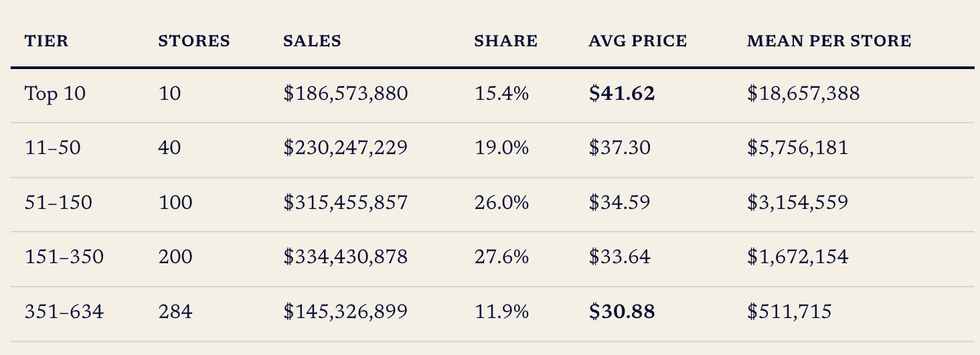
The state's 10 highest-revenue dispensaries sold products at an average of $41.62 per item during the study period.
The bottom 284 dispensaries averaged just $30.88.
That's a difference of approximately 35%.
And the pattern extends across the rankings.
Stores ranked 11 through 50 averaged $37.30 per item. Those ranked 51 through 150 averaged $34.59. Stores ranked 151 through 350 averaged $33.64.
 Research from New York 420 Week - https://newyork420week.com© 2026 New York 420 Week
In other words, average item prices declined consistently as store revenue rankings declined.
This doesn't mean the largest dispensaries are charging more for identical products. They may carry different assortments, serve different customer demographics, or generate greater sales of premium categories.
Nor does the relationship establish that higher prices cause better retail performance.
But it challenges a persistent assumption in cannabis retail: that lowering prices is the most reliable way to increase sales.
The highest-grossing dispensaries are selling a higher-priced mix of products, not the cheapest assortment in the market.
Meanwhile, approximately 43% of the dispensaries included in the study generated less than $1 million in estimated sales during the reporting period.
That's not proof those businesses are unprofitable, particularly since stores opened at different times.
But it illustrates how unevenly the market's growth is being distributed.
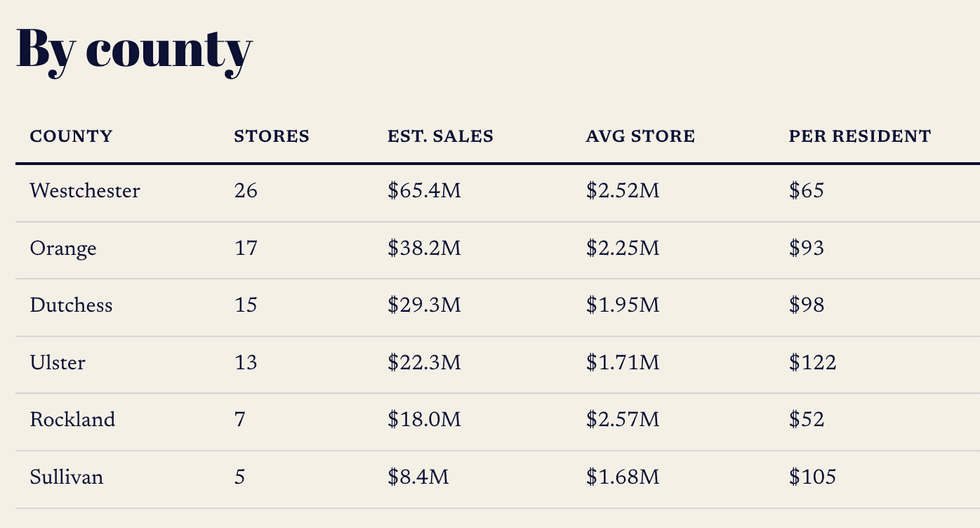
There's another important counterexample in Ulster County.
 Research from New York 420 Week - https://newyork420week.com© 2026 New York 420 Week
During comparable reporting windows in 2026, average daily cannabis sales in Ulster County increased 84.8% while average item prices remained essentially unchanged.
Even among the nine dispensaries already operating at the beginning of the year, sales increased 53.6%.
The takeaway isn't that higher prices are always better or that discounting never works.
It's that growth and declining prices don't have to go hand in hand.
And in an industry increasingly obsessed with pricing concessions, that distinction deserves serious attention.
Everybody Wants a Piece of New York
Revelry Buyers' Club has become an important gathering place for New York's cannabis community.
Produced by On The Revel, the event has helped connect the cultivators, entrepreneurs, advocates, retailers, and cultural voices working to establish the state's legal industry.
That contribution deserves recognition.
New York didn't invent cannabis culture, nor should it pretend to own it.
California's Emerald Triangle cultivators, legacy growers, and cannabis pioneers helped establish much of the agricultural craftsmanship, genetics, and knowledge that shaped modern cannabis.
But New York has its own extraordinary cultural influence.
Hip-hop, fashion, art, music, street culture, and generations of underground entrepreneurs helped make cannabis part of the city's identity long before the first licensed dispensary opened.
New York's legalization opportunity was never supposed to be about simply replicating the markets that came before it.
It was an opportunity to build something distinctive, rooted in the state's culture, communities, entrepreneurs, and history.
That's what makes the latest wave of industry attention both exciting and concerning.
September's Revelry gathering featured New York microbusinesses alongside established national brands, including Cookies, STIIIZY, and Wyld, according to Cannabis Now. GreenState's coverage highlighted the New York debut of Los Angeles-based Wizard Trees.
And Hall of Flowers is preparing to bring another wave of brands, buyers, investors, and industry professionals to the city later this month.
There's nothing inherently wrong with national brands entering New York.
Experienced operators can introduce quality products, professionalize distribution, create jobs, and raise competitive standards.
Nor should New York brands be insulated from competition simply because they arrived first.
But let's acknowledge the economic reality.
Many independent cultivators, microbusinesses, and social equity entrepreneurs are now competing with companies that possess greater resources, established consumer recognition, larger production capacity, and experience navigating mature cannabis markets.
Some can afford to invest heavily in distribution, promotional support, and market development.
Others cannot.
And when price becomes the primary consideration, those differences matter.
The challenge isn't that outside brands are entering New York.
It's whether the market is creating enough value for the independent businesses that helped establish it to compete sustainably.
More Brands, More Competition, But Not Necessarily More Opportunity
New York certainly isn't suffering from a lack of brands.
- YouTube © 2026 New York 420 Week
The September 16 New York 420 Week study identified 1,188 brands competing across the state's licensed cannabis market.
Yet the largest brand accounted for only 4.1% of brand-attributed sales.
On the retail side, the top 10 dispensaries generated approximately 15.4% of estimated statewide sales.
Those figures tell an important story.
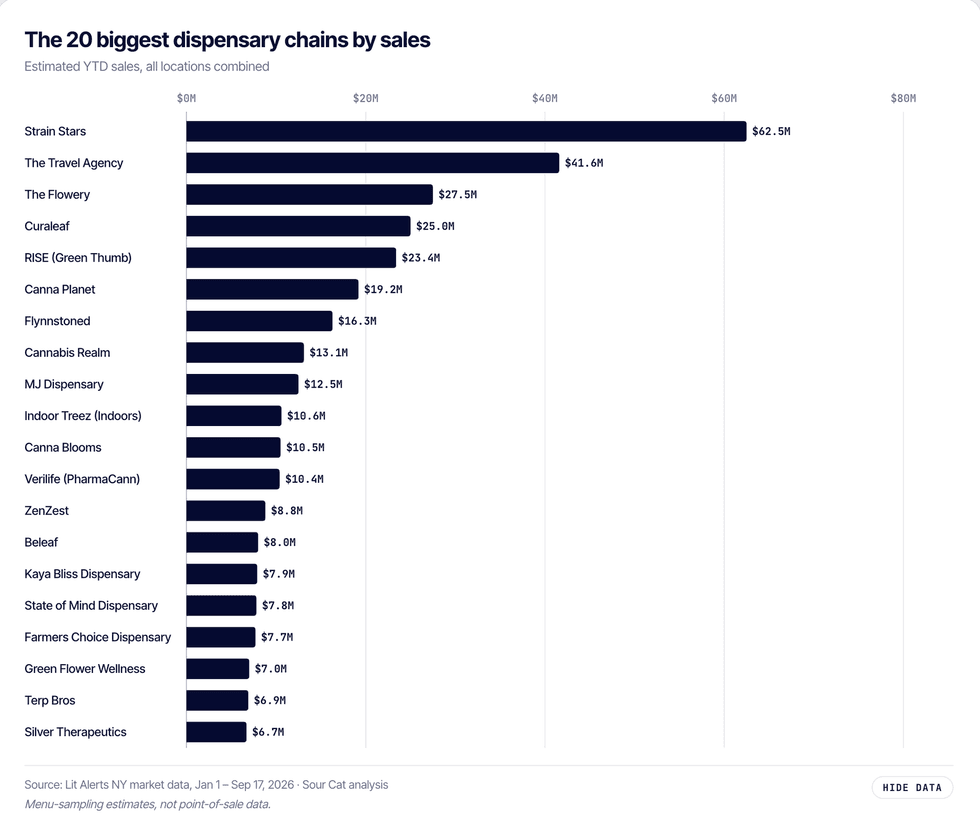
New York remains a highly fragmented market. No single brand or retailer controls anything close to a dominant statewide share.
 Source: Lit Alerts NY market data, Jan 1 – Sep 17, 2026 · Sour Cat analysisMenu-sampling estimates, not point-of-sale data.© 2026 New York 420 Week
That creates opportunities for new entrants.
But it also creates an intensely competitive environment in which hundreds of businesses are fighting for attention, shelf space, and repeat purchases.
And getting into a dispensary is only the beginning.
A brand can secure an initial order through aggressive wholesale pricing or a compelling sales presentation.
But what happens afterward?
Does the product sell through?
Do consumers return for it?
Can the retailer maintain its margins?
Can the brand sustain its economics once introductory promotions end?
Or does the product sit on the shelf until the next discount moves it?
These are the questions that determine whether distribution becomes a sustainable business or simply another expensive exercise in buying market share.
"Distribution is not demand. Shelf space is not loyalty. And revenue is not profitability."
Yet an industry obsessed with expanding its retail footprint can easily confuse all three.
The Trade Show Is Not the Store
Here's where the industry needs a reality check.
At events like Revelry, conversations revolve around innovation, genetics, quality, cultivation, craftsmanship, branding, and differentiation.
Back at the dispensary, those conversations frequently turn to wholesale cost, retail margins, promotional support, payment terms, and whether another brand can offer a better deal.
I've experienced that dynamic firsthand.
Through my work representing Empire Standard, Dada Exotics, and SpacePoppers, I've negotiated with buyers across New York and worked closely with dispensary owners, inventory managers, and budtenders.
I've seen how difficult it can be to sell a genuinely differentiated product when the immediate comparison is what another brand is willing to offer for less.
And I've watched how quickly the conversation can shift from product quality and consumer appeal to pricing concessions and promotional allowances.
None of those considerations are unreasonable.
Retailers have rent to pay, employees to support, inventory to manage, and customers who are increasingly price-conscious.
They need products that sell, and they need healthy margins.
But when price becomes the dominant consideration, something important gets lost.
Brands begin competing primarily on wholesale cost rather than consumer preference.
Retailers become conditioned to expect promotional concessions.
Consumers may become accustomed to buying on promotion rather than developing loyalty to a particular product.
And businesses find themselves working harder to sustain increasingly challenging economics.
That cycle is particularly difficult for smaller operators.
A well-capitalized company may be able to absorb temporary losses or invest heavily in promotions while expanding distribution.
An independent cultivator or emerging brand may not have that luxury.
The irony is that many of these businesses invest heavily in cultivation, product development, packaging, and brand building, only to compete on the one variable that can undermine their ability to recover those investments: Price.
"A packed booth doesn't guarantee sell-through. Distribution doesn't guarantee demand. And a discount doesn't create brand loyalty."
Those distinctions should be obvious.
But they're too often overlooked in an industry that celebrates how many doors a brand enters rather than how sustainably its products perform once they're there.
McDonald's Just Offered Cannabis a Warning
Interestingly, one of the clearest recent examples of discounting's limitations comes from outside cannabis.
In an October 12 Inc. Magazine article, Kimanzi Constable examined McDonald's efforts to stimulate sales through value meals, promotional campaigns, and discount-driven offers.
Despite those initiatives, McDonald's U.S. comparable sales increased just 0.8% in the second quarter of 2026, compared with 3.9% in the previous quarter.
McDonald's hasn't abandoned affordability, nor does that slowdown prove discounts caused weaker performance.
But its experience raises a familiar business question.
What happens when promotions become a substitute for creating a compelling customer experience and demonstrating product value?
McDonald's has spent decades building one of the world's most recognizable brands, with enormous purchasing power, sophisticated operations, and global scale.
Yet even a business with those advantages must balance affordability, customer experience, product innovation, and profitability.
Now consider the challenge facing an independent New York cannabis cultivator or single-store dispensary.
If a global fast-food giant cannot rely on discounting alone to drive sustainable growth, why would an emerging cannabis business with significantly fewer resources build its competitive strategy primarily around lower prices?
The lesson isn't that discounts are bad.
It's that discounting is a tactic, not a business model.
And when price becomes the primary reason customers choose one product over another, businesses risk weakening the differentiation that makes their brands valuable.
Premium Cannabis Isn't Dead. Differentiation Still Works.
Despite declining average item prices, New York consumers are not universally choosing the cheapest cannabis available.
The market data suggests that successful businesses can compete across a broad range of price points.
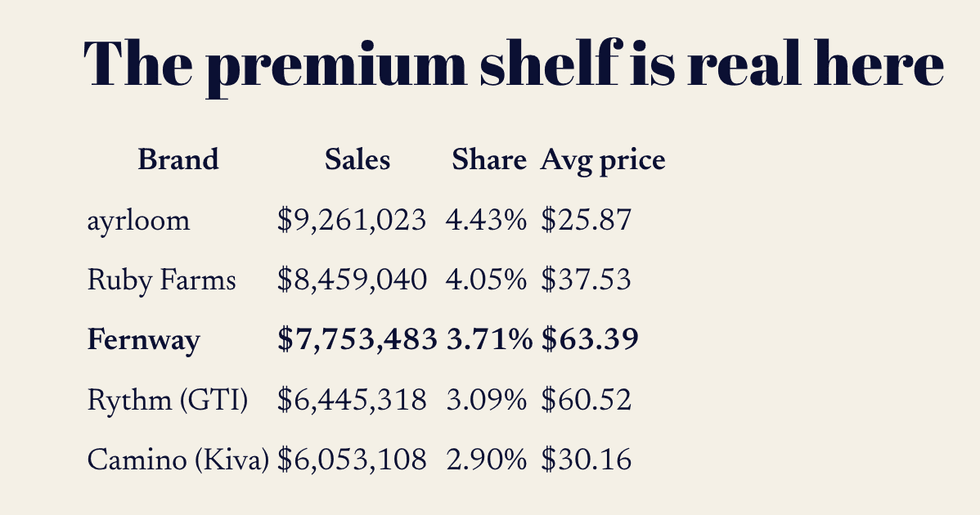
New York 420 Week's Manhattan market analysis estimated that Fernway generated approximately $7.7 million in sales at an average item price of $63.39.
Meanwhile, ayrloom generated approximately $9.3 million at an average item price of $25.87.
Both ranked among Manhattan's leading brands.
 Manhattan Cannabis Is a Commuter Market, Not a Local One - New York 420 Week© 2026 New York 420 Week
Those aren't like-for-like price comparisons. The companies sell different product assortments, and average item prices don't establish profitability.
But the figures illustrate an important point.
There is room for different value propositions.
The same applies to New York's smaller operators.
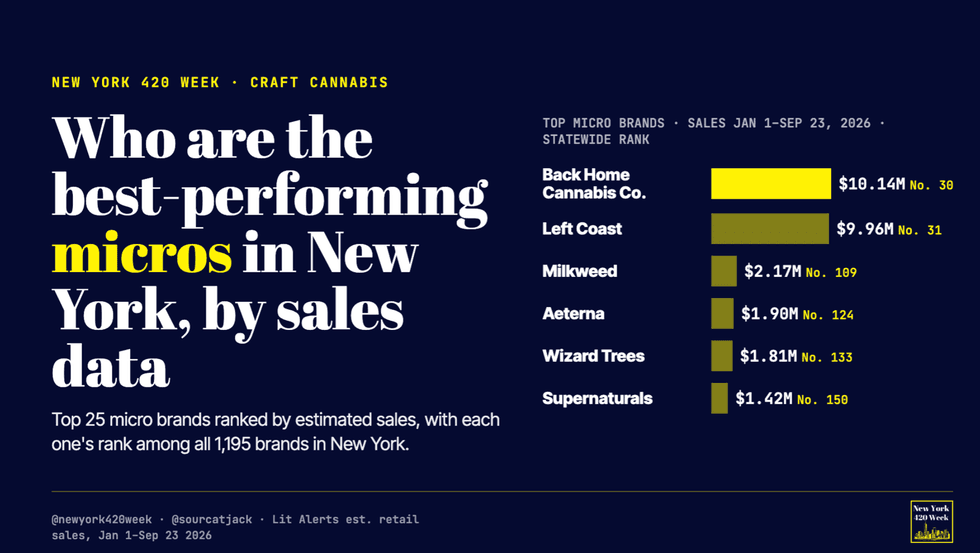
A separate New York 420 Week analysis estimated that microbusiness brands generated approximately $46.5 million in own-brand sales through September 23, representing roughly 4% of the branded market covered by its research.
Their average item price was $36.71, compared with $35.83 across all brands.
 The Best-Performing Cannabis Micros in New York - New York 420 Week© 2026 New York 420 Week
That doesn't mean every microbusiness can command a premium or that smaller operators are insulated from competitive pressure.
But it challenges the assumption that emerging brands can only compete by being cheaper.
Consumers still respond to quality, consistency, product experience, brand recognition, and trust.
The opportunity to differentiate exists.
The question is whether brands and retailers are doing enough to capitalize on it.
New York Doesn't Just Have a Pricing Problem. It Has a Merchandising Problem.
Walk into a typical New York dispensary and you'll often encounter an enormous assortment of products organized by category, brand, THC percentage, and price.
Flower. Pre-rolls. Vapes. Edibles.
Dozens of brands. Hundreds of SKUs.
And an online menu that can feel more like scrolling through a wholesale inventory database than shopping in a thoughtfully designed retail environment.
For experienced consumers who know exactly what they want, that may be sufficient.
For everyone else, it creates unnecessary friction.
What makes one eighth worth $25 and another worth $50?
Why should a consumer choose one cultivar over another?
What distinguishes a particular brand beyond its packaging, THC percentage, or promotional price?
When retailers don't answer those questions effectively, consumers default to the easiest available comparison: Price.
This is where cannabis has an enormous opportunity to learn from sophisticated specialty retailers.
Consider Sephora.
Beauty products, like cannabis, involve personal preferences, unfamiliar ingredients, product discovery, education, premiumization, and considerable variation in quality and price.
Sephora doesn't build its entire shopping experience around whichever brand offers the deepest discount.
It invests in merchandising, curated product discovery, staff expertise, and helping consumers understand why products differ.
Cannabis retailers should be thinking the same way.
And the market data reinforces why.
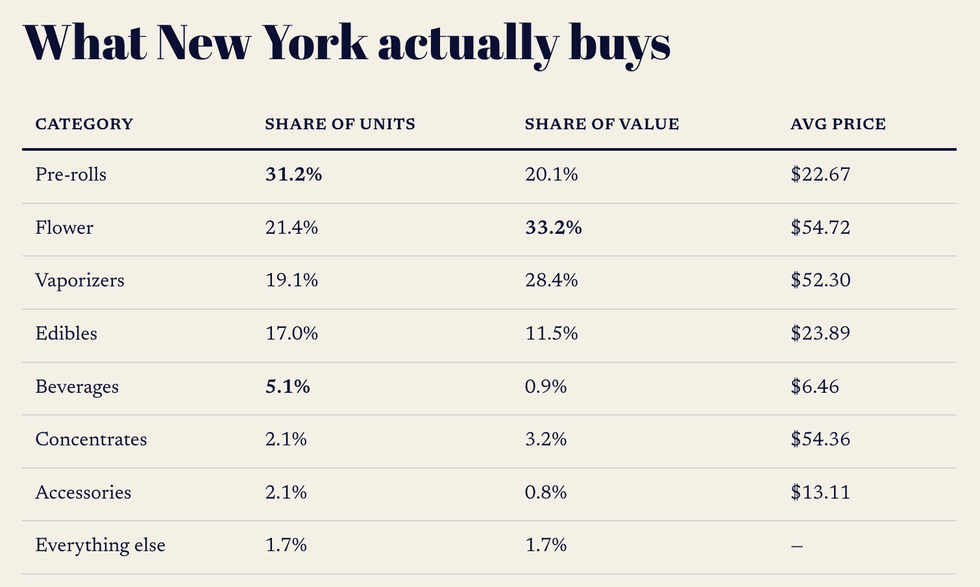
According to New York 420 Week's September 16 analysis, pre-rolls accounted for 31.2% of units sold but only 20.1% of sales value.
Flower represented 21.4% of units but generated 33.2% of sales value.
Vaporizers accounted for 19.1% of units and 28.4% of sales value.
Different product categories serve different commercial roles.
 Pre-rolls are the most frequently purchased thing in New York — nearly a third of all units — and they generate a fifth of the money. New York 420 Week© 2026 New York 420 Week
A retailer focused exclusively on moving the greatest number of units or stocking the lowest-priced products may be overlooking opportunities to improve assortment productivity and revenue mix.
That doesn't mean prioritizing expensive products indiscriminately. Gross margins, inventory turnover, customer demand, and repeat purchases all matter.
But it demonstrates why sophisticated retailing requires more than simply filling shelves and offering discounts.
Instead of making customers navigate hundreds of largely undifferentiated SKUs, organize assortments around meaningful consumer preferences.
Build clear good-better-best price and quality tiers.
Give budtenders the training and product knowledge to explain cultivation methods, genetics, freshness, product formats, and quality differences.
Use sell-through data, repeat purchasing, and inventory productivity to identify products that actually deserve shelf space.
And create online menus that help consumers discover products rather than simply search through inventory.
New York's cannabis regulations impose important restrictions on advertising, promotional practices, and product claims. Retailers must operate within those rules, without making unsupported health or therapeutic claims.
But those constraints make thoughtful merchandising more important, not less.
"Stop making customers shop your inventory. Start merchandising their decisions."
That's how retailers can create value beyond price.
And that's how brands can begin earning consumer preference rather than continually purchasing shelf space through concessions.
The Equity Promise Is Being Tested
There's another dimension to this conversation that deserves attention.
New York's cannabis legalization framework was designed partly to address the economic consequences of prohibition and create opportunities for communities historically excluded from the legal industry.
Social equity entrepreneurs, legacy operators, independent cultivators, and small businesses were supposed to have a meaningful opportunity to participate.
But participation and long-term economic viability are two different things.
A microbusiness may produce exceptional flower but lack the resources to support aggressive wholesale discounts.
An independent brand may have a loyal following but struggle to compete with larger operators offering extensive promotional support or favorable payment terms.
A single-store dispensary may deliver outstanding service but lack the purchasing leverage of a growing retail chain.
These disadvantages don't make competition inherently unfair.
But they raise important questions about whether the market's evolving economics align with legalization's original objectives.
New York doesn't need to protect every business from competitive pressure.
It does need to recognize that an industry increasingly dependent on scale, promotional spending, and financial endurance could undermine the opportunities it was designed to create.
The danger isn't simply that some businesses will fail.
That's an unavoidable part of any emerging market.
The danger is that New York could gradually lose the independent cultivators, entrepreneurs, and culturally rooted brands that make its cannabis economy distinctive.
And replace them with an increasingly interchangeable assortment of products competing primarily on price.
That's not an especially compelling vision for the future of New York cannabis.
Hall of Flowers Should Be About More Than the Next Big Drop
When Hall of Flowers returns to Pier 36 later this month, there will undoubtedly be another impressive display of cannabis entrepreneurship.
Expect innovative products, ambitious founders, sophisticated packaging, and plenty of conversations about expansion and distribution.
All of that deserves recognition.
But I'd like to see a different set of questions become just as important as who's launching what.
- Which brands are generating sustainable repeat purchases?
- Which retailers are increasing gross profit rather than simply chasing topline revenue?
- Which products are selling because consumers genuinely prefer them, rather than because they're discounted?
- Which dispensaries are creating shopping experiences that encourage discovery, build trust, and support long-term loyalty?
- And perhaps most importantly, which independent operators are building businesses that can still thrive five years from now?
Those questions are harder to answer than how many dispensaries carry a particular brand or how much revenue the market generated last quarter.
They're also far more consequential.
Revelry reminded us how much talent, creativity, ambition, and cultural energy exist in New York cannabis.
Hall of Flowers will undoubtedly reinforce that impression.
But the industry's future won't be determined by the size of its trade-show booths, the lines at product activations, or the number of purchase orders written during an event.
It will be determined in dispensaries, where consumers make purchasing decisions, retailers manage inventory, and brands either earn repeat business or disappear into the discount bin.
New York cannabis has already demonstrated that it knows how to generate excitement.
The sales figures demonstrate that consumer demand is real.
But demand alone isn't enough.
The next phase of New York cannabis won't be won simply by whoever sells the most products at the lowest price. It will be won by businesses that give consumers compelling reasons to choose them, return, and pay for the value they deliver.
And that starts with a fundamental shift in thinking.
"Stop making customers shop your inventory. Start merchandising their decisions."
Editor's note: Harrison Wise has worked in New York cannabis wholesale sales and brand representation, including with Empire Standard, Dada Exotics, and SpacePoppers. His observations draw partly on that firsthand experience. Market figures attributed to New York 420 Week & Lit Alerts include third-party estimated retail sales and are not audited financial results.


 Apple Fritter Strain - The Bluntness Riverside Greenery
  Indica vs. Sativa: Are These Cannabis Labels Outdated? - The Bluntness
  Georgia Pie Strain Profile: history, effects, and more - The Bluntness
  How many strains of weed are there? - The Bluntness