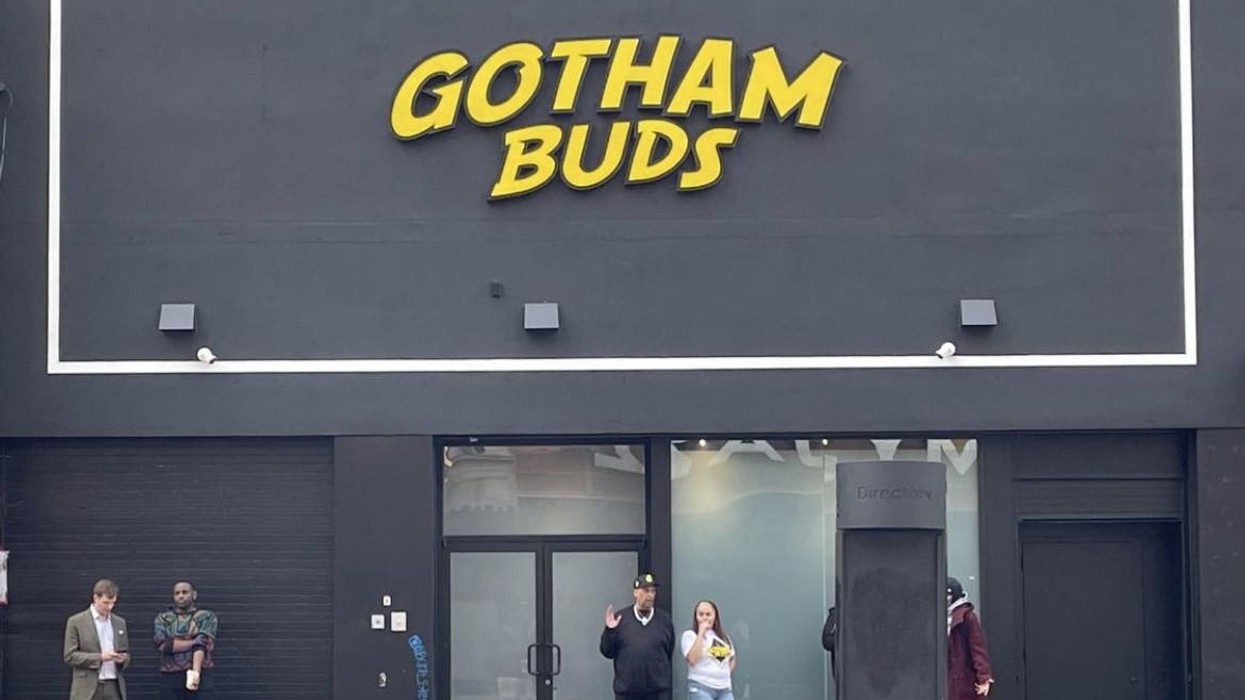

Gotham Buds opened across from the Apollo Theatre in 2023 as one of Harlem's first licensed dispensaries, a symbol of what New York's equity program was supposed to deliver. Three years later, the state has ruled that its owner never really had the business at all.
On August 6, the Cannabis Control Board issued a declaratory ruling finding that Gotham Buds' operating agreement violates the sole control requirements built into New York's Conditional Adult-Use Retail Dispensary (CAURD) program. It's the first ruling of its kind in the state, and it lands at a moment when equity licensees across New York are leaning harder than ever on outside capital just to survive. That combination makes this one worth reading closely, not skimming.
How the deal actually worked
The case is unusual because Gotham Buds asked for it. The company's qualifying justice-involved owner, Jeffrey Lopez, sought a ruling from OCM confirming his operating agreement complied with the law. OCM's review found the opposite.
On paper, Lopez held 51% of the vote and the title of Chief Operating Officer. In practice, the numbers told a different story. Two non-qualifying members, each holding a 19.5% stake, were entitled to 32% of profits apiece, while Lopez's majority stake earned him just 14%. A "Requisite Member Consent" clause gave those same two members veto power over ten categories of major decisions, including the annual budget, capital calls, and any change in management. A capital-return provision paid the minority members roughly the first $99,577 in distributable cash before Lopez saw a dollar.
Taken individually, none of those terms is unheard of in a commercial partnership. Taken together, the Board found something else: an owner with the title and none of the leverage. The ruling described Lopez as a controlling owner in name only.
What "Sole Control" actually requires
New York's equity regulations don't leave much room for interpretation once you read them closely. Under 9 NYCRR § 116.4, a CAURD licensee's qualifying owner has to hold real, continuous ownership of at least 51% of the business. That control has to extend to day-to-day operations, budgeting, and strategic decisions, along with the power to hire and fire managers. The rules also bar the kind of side letters and delayed recusal clauses that let a minority investor quietly run things from behind the scenes. A companion provision, 9 NYCRR § 116.7(c)(4)-(5), requires that the qualifying owner's share of the economics track that 51% stake for the full four-year conditional licensing period, not just the ownership percentage on the cover page.
OCM Executive Director John Kagia framed the stakes plainly. Sole control, he said, is how equity gets delivered, not a box to check. Board Chair Jessica Garcia described the ruling as the Board doing its job: stepping in when the standard isn't met to protect the integrity of the program.
Gotham Buds hasn't lost its license yet. The company has 30 days to submit revised agreements that fix the issues OCM identified, the option to contest the findings at the Board's next meeting, or the choice to surrender the license outright. OCM had already flagged deficiencies in a letter back in March, giving the company a chance to cure them before this became a public ruling. It didn't.
Why every management agreement in the state just got more interesting
Here's the part that should have compliance counsel and equity operators pulling their own operating agreements out of the drawer this week. Gotham Buds is not an outlier structure. Management services agreements, consulting deals, and capital arrangements that give a well-funded partner outsized control in exchange for financing are common across CAURD and equity licenses in New York, precisely because so many equity operators have struggled to access capital any other way. Oversaturation, price compression, and 280E's tax bite have made outside capital feel less like an option and more like a necessity for a lot of small operators trying to reach opening day.
That's exactly the tension this ruling exposes. The equity program was built on the idea that license holders would be real operators, not figureheads fronting for better-capitalized partners. But the market conditions that make equity licenses hard to finance on their own terms are the same conditions pushing operators toward the kind of arrangements OCM just struck down. New York can enforce sole control on paper. It hasn't solved the capital problem that makes violating it tempting.
OCM's own calendar makes the point for us. The same agency now scrutinizing equity ownership structures also just extended provisional CAURD and adult-use retail licenses through December 31, 2026, giving licensees still stuck in the pipeline more time to find viable real estate and finish buildout. Read those two moves side by side and a pattern emerges. A meaningful share of equity licensees still haven't opened years after receiving a license, real estate and capital remain the bottleneck, and the deals some operators strike to clear that bottleneck are exactly the kind of arrangements that just cost Gotham Buds its clean standing with the state. The extension buys time. It doesn't buy capital on terms that keep an operator in sole control.
For operators who've signed similar deals, the message from Albany is now unambiguous. OCM has stated it's strengthening its capacity to review business arrangements going forward, and this ruling gives the agency a detailed template for what a violation looks like: a wide gap between voting rights and profit share, veto rights stacked on top of a majority stake, and payout structures that quietly hand economic control to whoever wrote the check.
Anyone with a management agreement that resembles Gotham Buds' should assume OCM is reading it the same way the Board just read this one. The thirty-day cure window Gotham Buds got won't be a courtesy extended indefinitely.



 Americans Are Drinking Less - The Bluntness Photo by
  Americans Are Drinking Less - The Bluntness
  Americans are drinking less - The Bluntness Photo by