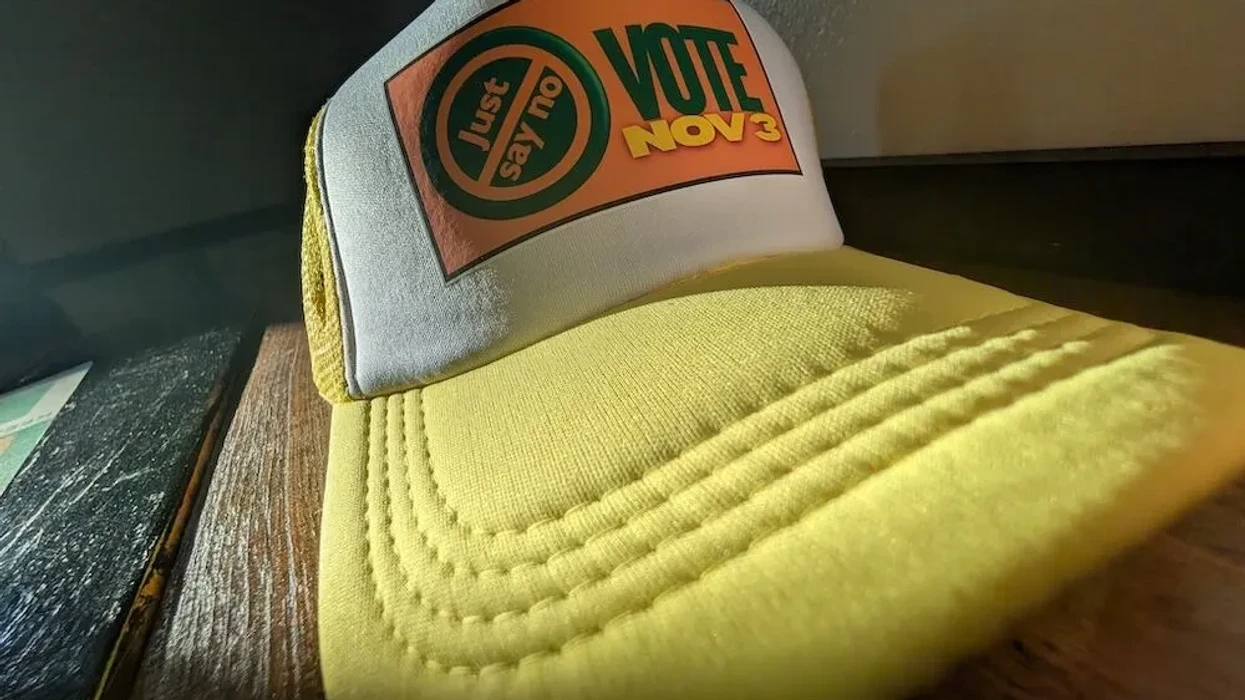
When Chris Faraone learned that petition circulators were gathering signatures outside Massachusetts retailers to put recreational cannabis back on the ballot, he decided to investigate.
Outside a Trader Joe's in Hanover and a Walmart in Weymouth, the veteran journalist and editor of Talking Joints Memo encountered what he believed were misleading explanations of a proposal that could dismantle the state's regulated adult-use cannabis market.
One circulator, according to footage in Faraone's forthcoming documentary, Just Say No!, described the petition as an opportunity to put marijuana back before voters so they could decide for themselves.
There was one problem with that pitch: Massachusetts voters had already decided.
In November 2016, nearly 54% of Massachusetts voters approved Question 4, legalizing adult-use cannabis. Nearly a decade later, the state has developed a multibillion-dollar industry, created thousands of jobs, and generated substantial tax revenue.
Now voters are being asked to reverse much of that decision.
On November 3, Massachusetts voters will decide Question 8, a proposal that would eliminate licensed recreational cannabis sales, roll back home cultivation protections, and dismantle key elements of the state's adult-use regulatory framework.
For Faraone, who has spent more than two decades covering cannabis, politics, and culture in Massachusetts, the repeal effort is more than another confrontation between legalization supporters and prohibitionists.
It's a warning about how quickly political gains can become vulnerable when the people who benefit from them stop paying attention. And the warning extends well beyond Massachusetts.
 A Repeal Campaign Is Testing Whether the MA Industry Can Defend It - The Bluntness Photo by Element5 Digital on Unsplash
A $10 Billion Industry on the Ballot
Massachusetts is not debating whether to launch a recreational cannabis market. It's considering whether to dismantle one that already exists.
According to the Massachusetts Cannabis Control Commission (CCC), licensed adult-use businesses surpassed $10 billion in cumulative gross sales in September 2026, less than eight years after the state's first recreational dispensaries opened.
The market generated approximately $1.65 billion in adult-use sales in 2025. By the end of August 2026, sales had reached another $1.09 billion.
The CCC reported approximately 15,000 individual employees working in the industry as of August, along with 782 operating cannabis businesses, including medical dispensaries. More than 100 businesses were identified as equity-owned or operated.
In fiscal year 2026, Massachusetts collected approximately $336 million in state and local cannabis-related taxes, according to the CCC. Since legalization, the industry has generated approximately $2 billion in tax revenue.
Question 8 would put a substantial portion of that economic activity at risk.
Under the proposal, adult-use retail sales would no longer be legal. Adults 21 and older could still possess up to one ounce of marijuana, including no more than five grams of concentrate, but possession of more than one ounce and up to two ounces would trigger a $100 civil penalty and forfeiture. The measure would also eliminate existing statutory protections for home cultivation.
Medical marijuana would remain legal, and existing adult-use operators could apply through an expedited process to become medical dispensaries. However, the measure does not guarantee that recreational businesses could successfully transition into the medical market. The law would take effect January 1, 2028.
That distinction matters. Question 8 would not make every form of adult cannabis possession illegal. It would instead eliminate the regulated commercial system through which most adult consumers currently purchase cannabis.
Repeal advocates argue that legalization has created public health and safety problems, including concerns about high-potency products, impaired driving, addiction, and youth exposure.
Those concerns deserve scrutiny. Cannabis carries real health risks, particularly for adolescents and some vulnerable consumers. But eliminating licensed adult-use retail does not necessarily eliminate cannabis demand.
It raises a different question: whether consumers would shift toward medical access, illicit sellers, or neighboring legal markets, and whether that shift would improve public health outcomes.
 Follow the Money: Who Is Behind the Massachusetts Cannabis Repeal Effort? - The BluntnessImage used with permission from Talking Joints Memo
Who Is Behind the Massachusetts Cannabis Repeal Effort?
The organization advancing Question 8 is the Coalition for a Healthy Massachusetts, whose campaign has received overwhelming financial support from SAM Action Inc., an organization affiliated with Smart Approaches to Marijuana (SAM).
SAM is a national organization opposed to commercial marijuana legalization and has been associated with prominent prohibition advocates, including co-founder Kevin Sabet.
According to October campaign finance reporting, approximately $3.48 million of the coalition's first $3.53 million in reported contributions came from SAM Action, roughly 98.5% of its funding.
SAM Action's nonprofit structure means the public cannot necessarily identify the individuals or organizations behind its contributions.
That funding concentration is significant. Whatever the local concerns motivating individual Massachusetts voters, the campaign's financial backing is overwhelmingly connected to a national anti-legalization organization.
But Faraone cautions against assuming the campaign is evidence of a broad public revolt against legal cannabis.
During an interview with The Bluntness, he argued that a meaningful segment of voters has always opposed legalization. The existence of that opposition does not necessarily mean public opinion has fundamentally shifted.
His concern is that organized campaigners can exploit that opposition, combined with ballot initiative rules and industry complacency, to create a political threat that extends far beyond their underlying public support.
Question 8's supporters, meanwhile, say their campaign reflects genuine concerns about how commercial cannabis legalization has developed.
In Just Say No!, which The Bluntness reviewed ahead of its public release, Coalition for a Healthy Massachusetts spokesperson Wendy Wakeman argues that the industry's commercialization, product potency, and public health consequences have exceeded what some voters expected when legalization passed.
Those arguments form the campaign's substantive case for repeal, even as its financing and petition tactics have attracted scrutiny.
A Repeal Campaign Without a Public Mandate?
For all the money and political maneuvering surrounding Question 8, Massachusetts voters appear remarkably uninterested in reversing legalization.
A Suffolk University/Boston Globe poll released October 20 found that 71.4% of likely voters intend to reject the measure, compared with just 21.4% who support it.
A separate University of Massachusetts Amherst/WCVB poll found 61% opposed and 31% in favor.
The opposition is not limited to cannabis consumers or industry stakeholders.
Governor Maura Healey, Senators Elizabeth Warren and Ed Markey, Representative Ayanna Pressley, Boston Mayor Michelle Wu, and more than 50 state lawmakers have publicly come out against Question 8. The coalition includes House Speaker Ronald Mariano and Senate President Karen Spilka.
For Faraone, the numbers reinforce an important distinction: opposition to legalization has always existed, but that doesn't necessarily translate into a growing public appetite for prohibition.
In fact, the latest polling suggests the opposite.
Yet the repeal campaign still succeeded in placing the future of a $10 billion industry before voters.
That may be the most revealing part of the story.
The question is no longer simply whether Massachusetts voters will reject repeal. It's how a campaign with comparatively little public support managed to force an established industry, its workers, and its political allies into defending a decision voters made nearly a decade ago.
The Petition Fight That Became a Legal Battle
One of the most contentious aspects of Question 8 has been the process used to gather the signatures necessary to qualify for the ballot.
In his forthcoming documentary, Faraone chronicles his investigation of petition circulators, the legal challenges that followed, and the cannabis industry's response.
The film includes accounts of petition circulators allegedly describing the measure in ways that obscured its consequences.
Faraone challenges the idea that voters were simply being asked to revisit legalization, pointing out that the proposal would eliminate existing rights and commercial protections established after the 2016 vote.
The repeal campaign disputes allegations of intentional deception.
In an interview featured in the film, Wakeman defended the professional signature-gathering company hired by the coalition, saying collectors were trained and instructed on the campaign's message. She acknowledged the possibility of misunderstandings but denied an intent to defraud voters.
The Massachusetts State Ballot Law Commission dismissed a challenge involving alleged misleading signature collection. A separate legal challenge reached the Massachusetts Supreme Judicial Court.
In Pineau v. Attorney General, decided June 12, 2026, plaintiffs argued that the proposed initiative improperly combined multiple subjects and that the attorney general's summary failed to adequately explain important consequences of the measure, including the elimination of adult-use social equity programs and host community agreement requirements.
The court rejected the challenge, finding that the initiative satisfied the state's constitutional requirements and that the attorney general's summary adequately conveyed the proposal's principal effects.
Importantly, the court's ruling did not adjudicate every allegation about how individual petition circulators described the measure. The Supreme Judicial Court case concerned constitutional certification and the adequacy of the official summary, not a comprehensive factual determination about signature-gathering conduct.
For Faraone, the larger lesson is procedural. By the time an industry recognizes the seriousness of a ballot initiative, organizers may already have gathered the signatures, secured the financing, and established the legal footing necessary to force an election. Challenging the measure afterward can be expensive, time-consuming, and unsuccessful.
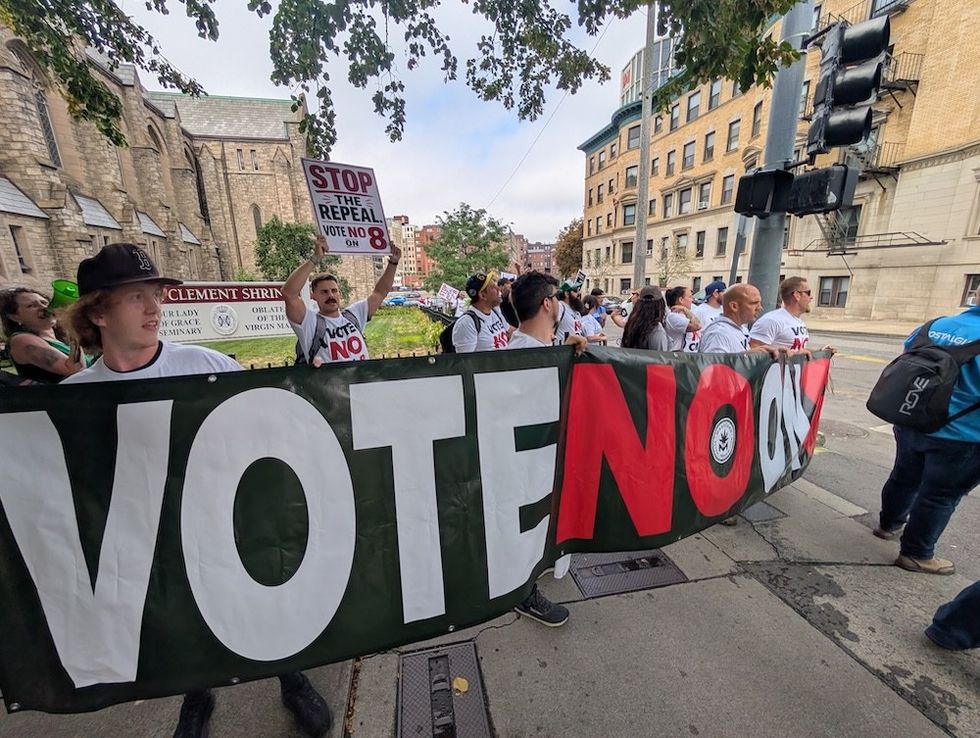 Winning the Vote Isn't Enough - Vote No on Question 8 - The BluntnessImage used with permission from Talking Joints Memo
The Cannabis Industry Was Caught Sleeping
Perhaps the most revealing part of Faraone's account is his acknowledgment that even people closely following the Massachusetts cannabis industry initially underestimated the repeal effort.
He recalls that when the campaign first surfaced, Talking Joints Memo was among the earliest publications to report on it. At the time, the effort did not appear particularly formidable.
The assumption was that a state with a mature adult-use market, a history of cannabis reform, and substantial public support for legalization would have little trouble rejecting a proposal to dismantle the system. That assumption proved costly.
In footage from the forthcoming documentary, Faraone visits a gathering of approximately 150 cannabis stakeholders in Framingham, where operators, trade associations, and advocates began organizing against Question 8.
He reports that some participants acknowledged that industry members had dismissed the threat only weeks earlier. By then, the repeal campaign had already established a substantial financial and organizational presence.
During his conversation with The Bluntness, Faraone emphasized that the mechanics of qualifying a ballot initiative can give a disciplined minority a significant advantage over a larger but fragmented opposition.
"The mechanics of qualifying a ballot initiative can give a disciplined minority a significant advantage over a larger but fragmented opposition."
A campaign does not need to persuade a majority of voters before it begins collecting signatures. It needs sufficient organization and resources to satisfy the state's qualification requirements.
Once the question reaches the ballot, the burden shifts to opponents to organize, raise money, educate voters, and defend the existing law.
For an industry accustomed to competing over shelf space, wholesale pricing, retail margins, and market share, that requires an entirely different kind of coordination.
Faraone's advice to operators in other states is straightforward:
- identify threats early,
- retain knowledgeable election counsel,
- work with established reform organizations, and
- don't assume a repeal campaign will collapse under the weight of its own arguments.
Organizations such as NORML and the Marijuana Policy Project can offer experience, but local businesses, consumers, and community advocates still need to mobilize.
The industry cannot outsource its political survival.
Legalization's Imperfections Are Not Necessarily a Case for Repeal
Ten years after voters approved legalization, the cannabis industry has not fulfilled every promise made during the campaign.
The economic stakes are becoming increasingly personal for the businesses and communities that have built livelihoods around Massachusetts' legal cannabis market.
In a recent episode of his High Functioning podcast, Good Feels founder Jason Reposa spoke with Nick Lazaro, a small-business owner, Millbury Select Board member, and candidate for state representative in the 7th Worcester District.
Lazaro, who opposes Question 8, argued that the consequences would extend beyond dispensary owners to employees working in cultivation, manufacturing, retail, operations, and quality control.
For Reposa, those concerns are grounded in the experience of operating a licensed cannabis business.
He recalled that Good Feels initially paid approximately $2,000 per month for banking services before negotiating a lower rate, illustrating the additional costs cannabis companies face because of federal prohibition. Advertising restrictions and other compliance requirements add further complications.
"It's like playing startup in hard mode," Reposa said.
The irony is difficult to ignore. Massachusetts entrepreneurs have spent years investing in facilities, employees, compliance systems, and businesses designed to operate within the state's legal framework.
Now they are being asked to defend the continued existence of that framework.
Lazaro also raised concerns about the complexity of the ballot itself. With numerous questions facing voters, he argued that even politically engaged residents may struggle to understand the implications of each proposal.
That concern echoes a central theme of Faraone's investigation: whether voters fully understand the distinction between regulating an imperfect cannabis industry and eliminating adult-use retail altogether.
Social equity programs have encountered obstacles. Independent operators face intense competition. Worker protections and business sustainability remain ongoing concerns. The regulated marketplace is far from perfect.
Those shortcomings deserve serious attention. But Faraone challenges the suggestion that imperfections in legalization justify returning adult-use sales to the illicit market.
His argument is that Massachusetts is still developing a relatively young industry. Regulatory systems, worker protections, and equity programs can be improved through legislation, enforcement, and market reform.
The unregulated market offers no comparable framework for systematically improving product testing, workplace standards, or economic opportunity.
Question 8 would also affect programs intended to address the harms of past cannabis prohibition.
In its September economic update, the CCC reported that nearly $60 million in financial assistance had been provided to equity licensees since 2024 through the Cannabis Social Equity Trust Fund.
The Supreme Judicial Court's decision in Pineau confirms that the initiative would repeal statutory provisions establishing the adult-use social equity program and related trust framework.
That creates a particularly difficult contradiction.
Massachusetts encouraged entrepreneurs, including people from communities disproportionately affected by prohibition, to participate in a legal industry. Some invested substantial capital, secured licenses, hired employees, and built businesses around that opportunity.
Now the state is considering eliminating the market those entrepreneurs were encouraged to enter.
Whatever voters think about cannabis commercialization, those consequences deserve a place in the debate.
From Competitors to Coalition
For all the industry's initial complacency, the repeal effort has also produced something Massachusetts cannabis operators have often struggled to achieve: cooperation.
Faraone's forthcoming documentary captures businesses and advocates coming together across competitive boundaries.
One example is a collaborative preroll initiative involving multiple Massachusetts cultivators, organized around raising awareness and supporting the campaign against repeal. Another is a cannabis walk organized by Haverhill-area businesses to engage local communities.
These efforts may appear modest compared with multimillion-dollar campaign contributions, but they represent an important shift.
The operators involved are not simply defending individual businesses. They're defending the legitimacy of an entire regulated marketplace.
And they are discovering that competitors with different business models, ownership structures, and commercial interests share a common political vulnerability.
A cultivator, a retailer, a delivery operator, and a social equity licensee may disagree about pricing, regulation, or market concentration. But those disagreements become secondary when the continued existence of their market is on the ballot.
The question is whether that cooperation survives after Election Day.
Could Massachusetts Become a Blueprint for Cannabis Repeal Elsewhere?
Faraone is not convinced that Question 8 represents an unstoppable national movement against legalization.
He sees the Massachusetts campaign as part of a broader pattern of organized opposition operating within the particular political and procedural opportunities available in individual states.
In his interview, he pointed to Maine and Arizona as other states worth examining, while emphasizing that each state's ballot rules, political culture, and cannabis market create different conditions.
Maine, in particular, deserves attention because its petition process differs from Massachusetts', potentially giving organizers a different timeline for building campaigns.
The larger concern is not that every legal state is equally vulnerable. It's that an unsuccessful repeal campaign can still impose substantial costs on the industry it targets.
Businesses must divert money, leadership attention, and organizational resources toward defending rights and licenses they believed were already settled.
Even if the repeal effort loses, it can disrupt normal operations and force the industry to fight on terrain chosen by its opponents.
Legalization is not a permanent political guarantee. It is a statutory and regulatory system that can be challenged through the same democratic mechanisms that created it.
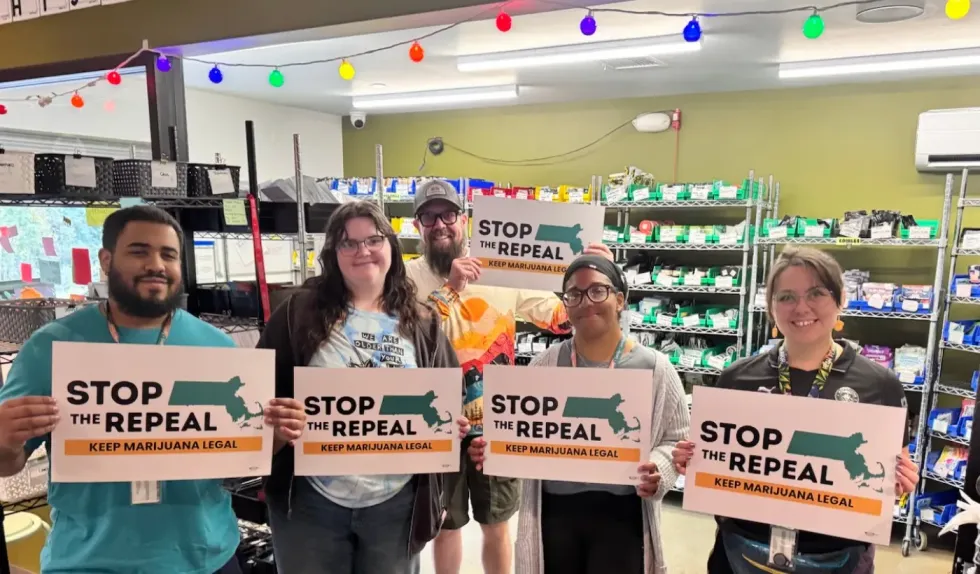 MA dispensary workers showing their opposition to the repeal campaignImage courtesy of Talking Joints Memo
Winning the Vote Isn't Enough
With multiple polls showing overwhelming opposition to Question 8 and a growing coalition of elected officials urging its defeat, Massachusetts' regulated cannabis market appears likely to survive November 3.
But Faraone argues that the margin matters.
A narrow defeat could encourage repeal organizers to regroup, refine their approach, and look for more favorable conditions elsewhere. A decisive rejection could make Massachusetts a much less attractive model for future campaigns.
Even so, the industry should resist the temptation to interpret a victory as proof that the threat was never serious.
Question 8 has already demonstrated that legalization does not make an industry politically invulnerable. A sufficiently organized and financed campaign can force businesses to spend time, money, and political capital defending laws they assumed were settled.
The real test may come after Election Day.
Will the cooperation forged between competing operators, grassroots advocates, and political leaders survive once the immediate threat disappears? Or will the industry return to business as usual until the next petition circulator appears outside a supermarket?
Massachusetts voters may be preparing to deliver a decisive answer on repeal.
Whether the cannabis industry has learned anything from the experience is another question.
A Personal Note from the Publisher
Legalization was never just about selling weed. It was about ending a failed policy, protecting personal freedom, and creating opportunities for people who spent decades fighting for the right to participate in this industry.
Massachusetts helped lead that change. And while the legal cannabis market is far from perfect, the answer isn't to dismantle it. It's to make it better.
Progress is hard won. It's also easier to undo than most people realize.
If you're reading this and you live in Massachusetts, vote NO on Question 8 on November 3.
Don't let a decade of progress go up in smoke.


 Apple Fritter Strain - The Bluntness Riverside Greenery
 Indica vs. Sativa: Are These Cannabis Labels Outdated? - The Bluntness
 Georgia Pie Strain Profile: history, effects, and more - The Bluntness
 How many strains of weed are there? - The Bluntness