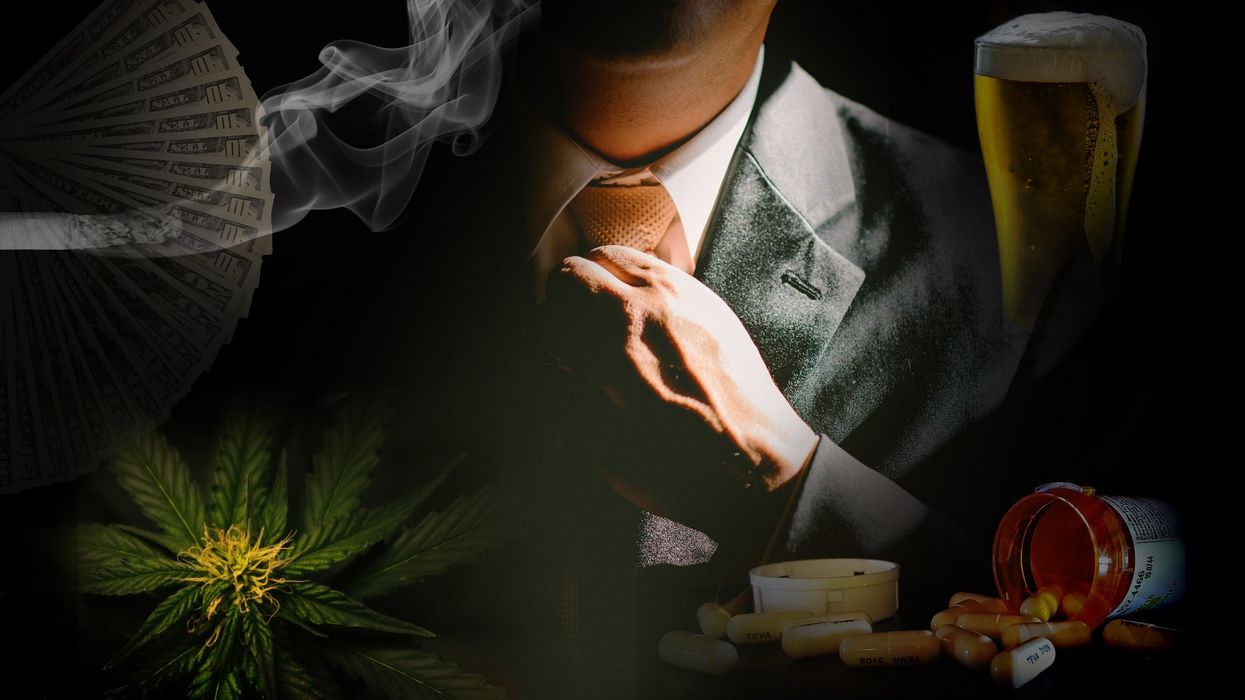

As more big business movers and shakers appear to be ratcheting up their incursions into the cannabis industry, industry advocates are stepping up their defense.
In March, the U.S. saw the creation of a federal lobbying group – the Coalition for Cannabis Policy, Education and Regulation – with the goal of advancing a federal regulatory framework for cannabis, and including members from both the tobacco and alcohol industry.
Kassandra Frederique, executive director of the Drug Policy Alliance issued a follow-up statement that same month:
“We have long been concerned about the entry of large commercial interests into the legal marijuana market. Big Alcohol and Tobacco have an abysmal track record of using predatory tactics to sell their products and build their brands – often targeting low-income communities of color and fighting public health regulations that would protect people. It is predictable, but reprehensible, that industries that have allowed the arbitrary distinction between licit and illicit drugs to stand for so long now want to end a form of prohibition in order to bolster their bottom line.”
Ironically, the cannabis industry is facing its own big-time moment. The cannabis legalization bill, The Cannabis Administration and Opportunity Act , currently being discussed in Congress shows that the industry has reached the status of a big business by virtue of its accelerating sales and continued growth across the country, and identifies certain restrictions that some interpret as worrisome to any of the cannabis companies that have partnerships with Big Alcohol and Big Tobacco. How that will pan out is still to be determined.
Is it big business incursion time for the cannabis industry? Or is the cannabis business itself so big that Congress wants to put more guardrails on how big it can get, and who it can partner with, essentially making cannabis a victim of its own success? Is the industry ready to deal with these big issues? Or should the pushback continue?
Let’s take a look at the breadcrumbs:
1. Big Tobacco
Steady and somewhat stealthy inroads to cannabis keep showing up in tobacco companies, some with a biotech edge.
In 2016, Philip Morris International invested $20 million in an Israeli medical start-up that developed a metered-dose vaporizer of raw plants (including cannabis) for medical use.
In 2018, British multinational tobacco company Imperial Brands invested in Oxford Cannabinoid Technologies (OCT), a biopharmaceutical company focused on researching, developing, and licensing cannabinoid-based compounds and therapies.
Altria Group, makers of Marlboro cigarettes, agreed to buy a 55 percent stake in the Canadian cannabinoid company Cronos Group for about $1.8 billion in 2018. Altria went further by lobbying on the regulation of marijuana sales in Virginia in February 2021.
That same month, the Virginia General Assembly passed recreational legalization measures with an effective date of January 2024. In April, the state moved the date for legalized recreational cannabis up by three years, to July 1, 2021. Did Altria lobbyists influence that move? Hmmm…
2. Big Alcohol
This is one of the most entrenched formerly non-cannabis industries that is quickly turning to cannabis, in part to make up for lagging sales.
Molson Coors introduced a line up of five cannabis infused beers in August, 2020; and some local craft breweries are making non-alcoholic THC infused beer, such as Denver-based Ceria.
The 2017 cannabis/Big Alcohol deal between Canopy Growth and Constellation Brands, makers of Negro Model and other popular brands of beer, continues developing. For example, Constellation Brands, through its subsidiary Greenstar Canada Investment, has increased its stake in Canopy Growth Corporation in a $174 million deal in May 2020.
And in December 2020, Toronto-based Tilray, a cannabis research, cultivation production and distribution company, partnered with another Canadian cannabis company, Aphria, in a $4 million deal that includes Aphria’s November 2020 acquisition Sweet Water Brewing company, a cannabis lifestyle branded craft brewer.
By the way, beer is a natural complementary product for cannabis – cannabis and hops are closely related genera of Cannabaceae that share many unusual biological and phytochemical characteristics.
3. Big Pharma
Big Pharma is already a player in the cannabis space. And they are not hiding their intentions. This includes Johnson and Johnson, with Avicanna, headquartered in the company’s JLABS, J&J’s medical and science incubator in Toronto. Avicanna is a pharmaceutical company working on cannabinoid-based products.
Abbie, formerly Abbott Labs, a medical devices and healthcare company, filed for at least 59 cannabis-related patents in the U.S., according to a 2019 report.
Israeli pharmaceutical company, Teva Pharmaceuticals, through its subsidiary, Salomon, Levin, Elstein (SLE), announced that it would handle distribution of the products of Canndoc, a subsidiary of InterCure that specializes in medical marijuana. InterCure's CEO is former Israeli Prime Minister Ehud Barak.
And Bayer marketed GW Pharmaceuticals Sativex, often known by the USAN name nabiximols, as a complex botanical formulation that contains the principal cannabinoids THC and CBD in addition to specific minor cannabinoids and other non-cannabinoid components.
Another sign of the times that could be catching the eyes of Big Pharma movers and shakers happened in December 2020, when 53 member states of the Commission on Narcotic Drugs (CND), the United Nation’s central drug policy-making body, voted to remove cannabis from Schedule IV of the 1961 Single Convention on Narcotic Drugs — where for 59 years, it was listed alongside specific deadly, addictive opioids, including heroin, recognized as having little to no therapeutic purposes.
According to news reports, the decision could drive additional scientific research into the plant’s medicinal properties, perhaps giving more cover that has been hinting it would like to reschedule cannabis (not deschedule it) which would help legalize it for medical research.
4. Big Investors
Warren Buffet’s Berkshire Hathaway invested in cannabis in October 2019 as a result of a core Buffet holding, Kraft Heinz, that invested $23 million in a cannabis technology startup through their venture capital wing.
Another of Berkshire Hathaway’s holdings, Mondelez, Inc., makers of Oreos and Chips Ahoy, is reportedly thinking of creating CBD-infused products.
In 2018, California Public Employees Retirement Systems (CalPERS) — the biggest public pension fund in the U.S. with 2 million members and $392.5 billion in retirement funds —invested in both Insys Therapeutics, a cannabis-focused biotech firm, and Tilray, a major cannabis producer in Canada that recently acquired a craft beer company. CalPERS owned 1,617 shares of Tilray as of May 2018.
Banks are itching to get more cannabis investor money and work with cannabis businesses without fear that the federal government will intervene. The is jumping into the cannabis business. And bankers from all 50 U.S. states to advance the a banking-specific bipartisan solution that would “address the reality of the current marketplace and allow banks to serve cannabis-related businesses in states where the activity is legal.”
5. Big Agriculture
Cannabis farms are generally small operations. But bigger operations are making inroads, and they look more and more like Big Ag operations.
For example, the total footprint of the 6,000-plus permitted cannabis farms in California is estimated to be less than 2,000 acres out of a total of 27 million acres of land under agricultural production.
The largest North American grower producing cannabis exclusively in a greenhouse is Arizona’s Copperstate Farms at nearly 2 million square feet, while the largest cannabis grower both outdoors and in a greenhouse is Ultra Health in New Mexico, at 9.2 million square feet total but working on a $20 million expansion.
Legacy cannabis growers, especially in California, are pushing back saying that Big Ag will kill the rural cannabis farmer. Big Ag farmers see the growth of cannabis farming, and believe now is the time to cycle out the novices from the pros, with some calling it “the next frontier of commercial agriculture.”
Rumors proliferate about Monsanto developing a genetically modified cannabis seed so that they can corner the market. And Toronto-based global cannabinoid company, Cronos Group, has partnered with Ginkgo Bioworks to produce cannabinoids in a lab—Ginkgo has developed business relationships with Big Ag clients such as Archer-Daniels-Midland and Cargill, Inc.
Who else? Amazon, the second largest private employer in the U.S., which ended cannabis testing for its employees, is lobbying for legalization with its public policy team in the hopes of being a big legal cannabis distributor.
American Cannabis Company, seller of ancillary products to the cannabis industry, inked a deal in March 2018 with WalMart and Home Depot to sell a cannabis-related soil product.
Colgate-Palmolive is getting more involved in the cannabis business, although in a more conservative way with CBD products.
Time will tell. But there’s a sort of snowball-rolling-down-the-hill effect happening right now as more players take a look at partnerships and product development, with the cover of major corporations that have already done their own due diligence on cannabis and coming to the conclusion: They’re not on the sidelines anymore.
Need a little more Bluntness in your life? Sign Up for our newsletter to stay in the loop.



 Here's a look at the Open Your Heart curated set.Image from A Golden State Facebook page